
How a design team created an unforgettable experience for young visitors in Vero Beach, FL
By Emmanuel Didier, Creative Director, Didier Design Studio
Within the lush tropical landscape of McKee Botanical Garden is an area designed to let a child’s imagination take flight.
It is a place where grandparents watch their grandchildren disappear into the trees, where parents rediscover the thrill of exploration, and where children experience something increasingly rare: an authentic encounter with nature. Its purpose is to nurture a lifelong relationship between children and the natural world.
I believe that relationship begins with a single moment.
Almost everyone remembers discovering a hidden place in nature—a secluded clearing, a tree that became a fortress, a path no one else seemed to know. For a brief moment, we are convinced we are the first to find it. It belongs to us, and we belong to it.
Those moments stay with us. They become the stories we tell, the places we revisit in memory, and the foundations of our relationship with nature, our landscape, and our world.
I often say, “We have a garden when we have a story.”
Gardens are not just collections of plants. They are places where stories unfold. They cultivate memories and connections: between people and nature, between individuals, across families, and down through generations. The most memorable gardens invite us not only to observe them, but to participate in them. That idea of “immersive connection” became the guiding principle for the Children’s Garden at McKee Botanical Garden.
When the team at McKee first reached out, they wanted to transform how families engaged with the landscape. While families had long enjoyed exploring its historic jungle trails, their experience was largely observational; McKee set out to change that. The Children’s Garden was conceived as a place where young visitors wouldn’t just look at nature, but actively inhabit it—learning through hands-on exploration, imaginative play, and pure discovery.
Beginning in 2015, I had the privilege of leading our team at Didier Design Studio through this process. Over the next two years, working alongside a talented local team of engineers and landscape architects, we translated that shared philosophy into the technical drawings and physical details of a truly one-of-a-kind environment.
McKee is a remarkable jungle—a lush landscape containing more than 10,000 species of tropical plants. Walking beneath its dense canopy is completely transportive. The filtered light, towering palms, giant banyans, and layered vegetation dissolve the outside world. Looking upward, the sky appears only in scattered fragments between leaves.
I still remember my first visit. Standing beneath the canopy, I lost sight of the horizon. Instead, I found myself enveloped by an astonishing living world. It felt ancient, mysterious, and wonderfully alive. The extensive diversity of textures and plant species inspired me. I could imagine children running through dense foliage, eager to explore; a rich, fertile ground to grow their imagination. Rather than creating a playground beside this extraordinary landscape, we wanted the Children’s Garden to become a miniature McKee—a hidden world waiting to be discovered.
A Jungle Full of Wonder
Working closely with the garden’s leadership, staff, and stakeholders, we began crafting not simply a design, but a narrative. The question became: What story would children step into? The answer emerged from many sources: child psychology, theories of exploratory play, classic adventure literature, the unique ecology of Florida—and, unexpectedly, a suggestion from one of the board members: “What about a pirate ship?”
At first, it sounded almost absurd. But then a real-life story surfaced. In 1715, eleven Spanish treasure galleons were destroyed by a hurricane off Florida’s Treasure Coast, not far from Vero Beach. The ships carried immense riches destined for Spain. Their loss has fueled centuries of legends and treasure hunting.
What if we reimagined that history? What if another violent storm—one echoing today’s increasingly powerful hurricanes and reminding us of our changing climate—had lifted one of those galleons from the sea and carried it deep into the jungle? What if the surviving crew had dismantled the ship, using its timbers, ropes, and sails to build a village among the trees? And what if children discovered the remains centuries later?
Suddenly, the garden had a story.
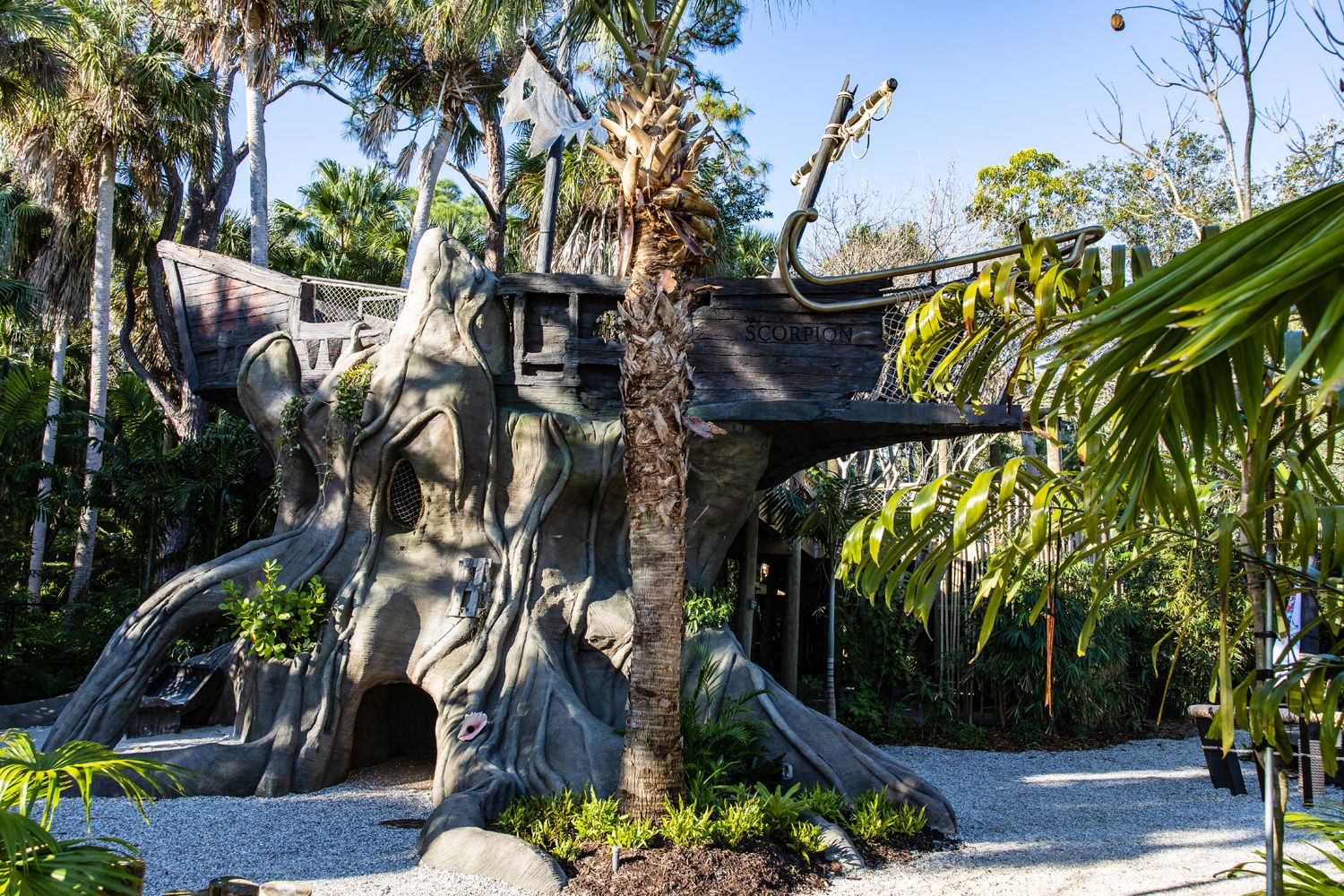
The pirate galleon became the teaser to the story within. Partially hidden within the vegetation, it is visible only in glimpses. Spotting the dark hull suspended high within an enormous banyan immediately awakens curiosity, inviting children to venture deeper into the garden.
Children learn as they play. More importantly, they learn as they explore with their bodies: Over. Under. Through. This is what we mean by an “immersive” experience for children—engaging their senses and making connections as they encounter a living landscape.
The Shipwreck in the Trees
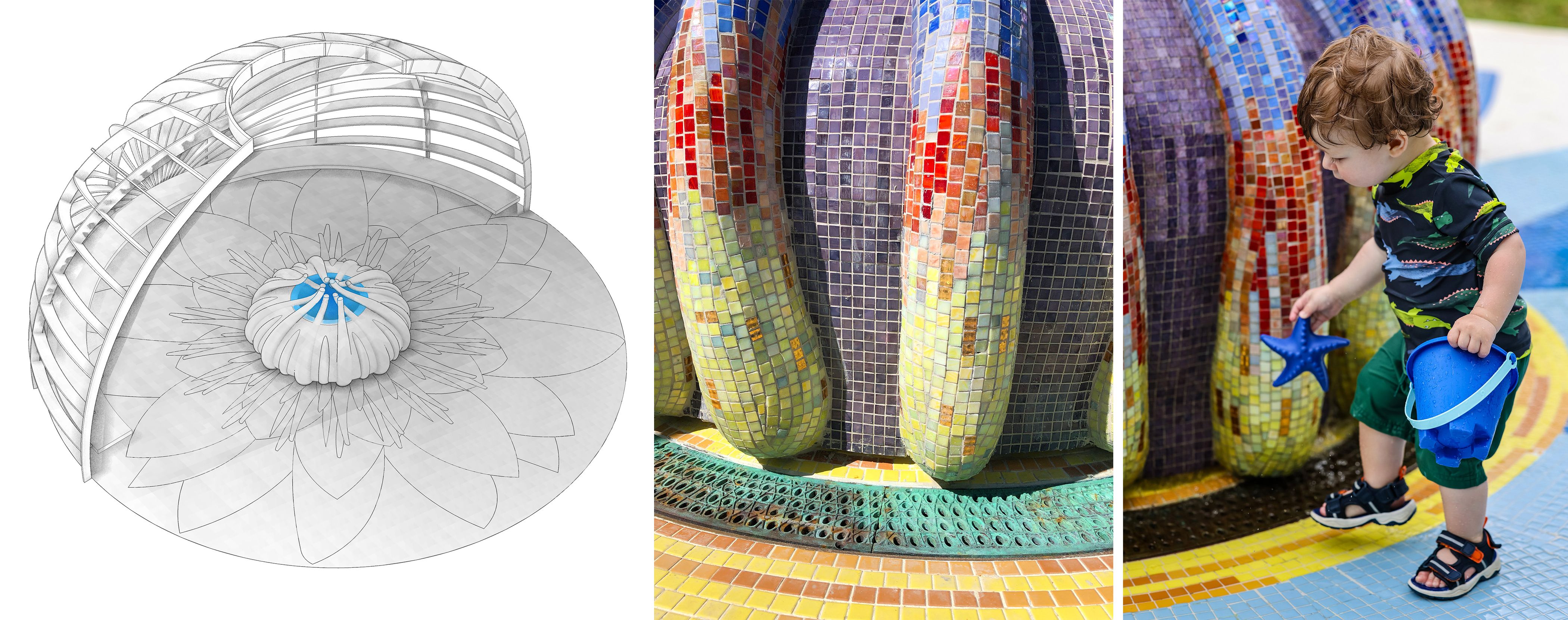
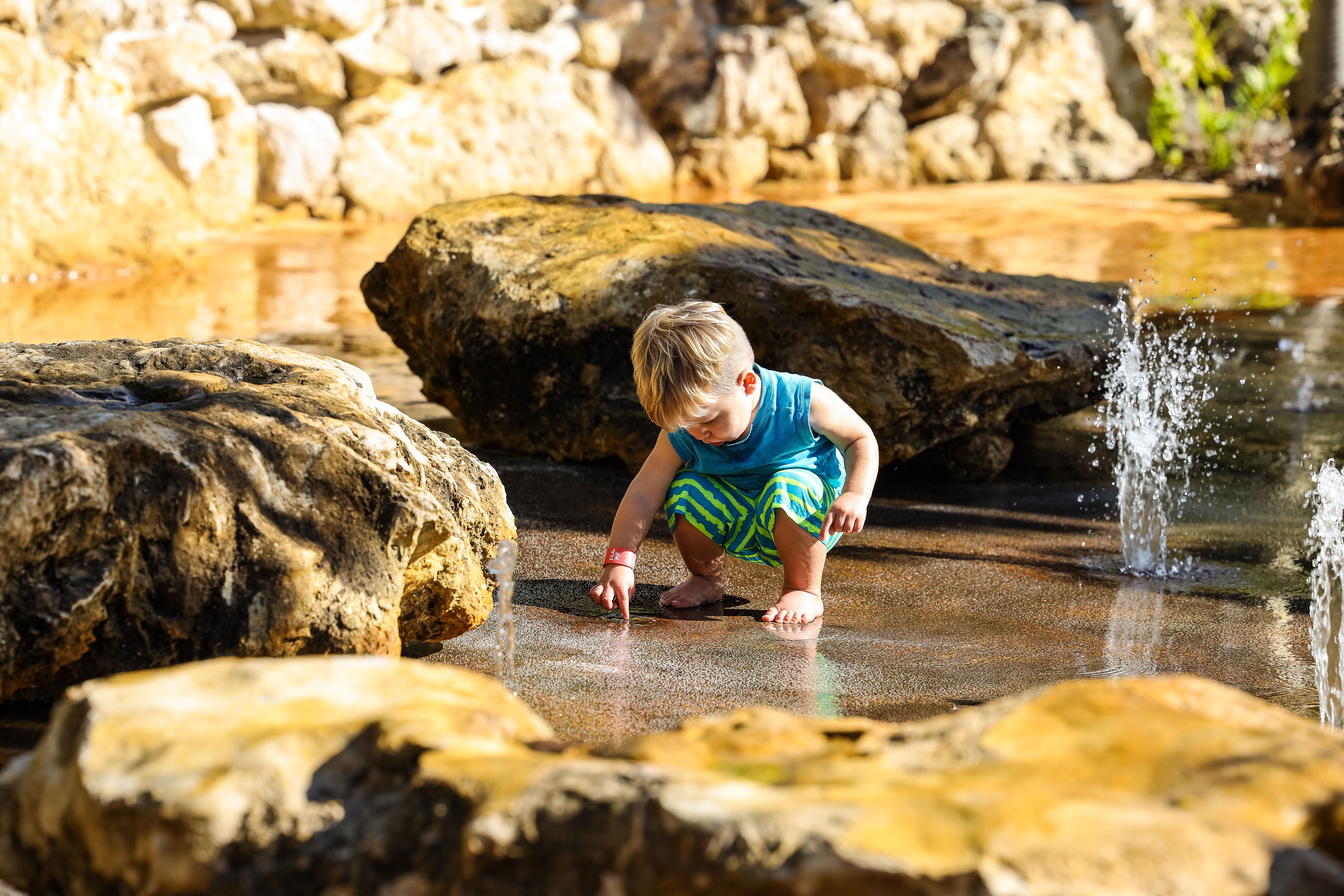
As they start their journey, they begin reading the landscape itself and learning about the rich ecology of the Florida region. The journey starts at ground level, where shallow water winds through exposed karst limestone, revealing the geological foundations beneath Florida’s landscape. Off to the side, a water lily fountain welcomes visitors and caregivers to pause and let children venture deeper into the jungle on their own. The shaded patio under a domed arbor covered in vines celebrates one of the most precious collections of McKee Botanical Garden: the water lily. The floor of the circular patio features mosaic tiles patterned after the sepals and petals of the flower.
The stamens of the flower emerge to create the central fountain at the heart of the design. Water releases between the stamens, which are covered in rich arrays of colorful glass tiles, splashing rhythmically onto the garden floor.
The garden unfolds vertically as much as horizontally.
The ascending journey through the garden’s layers is a reference—and translation—of Gaston Bachelard’s The Poetics of Space. In his book, he celebrates the vertical dimension of space in architecture, from the cellar to the attic. In our garden, I translated this poetic dimension into the world of the jungle: from the forest floor and the earthen experience of roots where creatures live, to the upper canopy where the horizon expands to reach the sky.
From the subterranean layers of karst stone, the ponds, and the water lily fountain, children move through herbaceous meadows alive with pollinators before entering progressively denser layers of shrubs, palms, vines, and towering trees. Children climb over dunes, crawl beneath roots, cross bridges, enter hollow trees, and travel through the jungle canopy itself. For a moment, not unlike the protagonist in Italo Calvino’s The Baron in the Trees, they inhabit the canopy. From this elevated world, a network of suspended boardwalks, rope bridges, platforms, tunnels, and treehouses extends into the forest. The ship has become more than an artifact—it has become the center of a hidden village reclaimed by nature.
Vines drape across broken masts. Weathered planks become bridges. Platforms disappear into foliage. Every turn suggests another discovery waiting just beyond sight. Children make the story their own in a space designed for dramatic play without a prescribed script. That openness is essential and intentional; children own the place. The best play environments do not tell children what to think—they invite them to invent and imagine.
Designing for the Senses
As the journey continues deeper into the jungle, quieter discoveries emerge. Giant mushrooms carved with poems. Tiny shelters woven from branches. Collections of nuts and flowers. Perhaps fairies live here; perhaps they don’t. Uncertainty is part of the experience.
Every sense is engaged: the scent of damp earth, the texture of bark, filtered sunlight through giant leaves, the sounds of water and birds, and the anticipation of what lies around the next bend. Long after children have left the garden, those sensations remain. Years later, they may not remember every bridge they crossed or platform they climbed, but they will remember their own discoveries.
They will remember feeling ownership of a place in nature. They will hold memories of rich environments with abundant plant diversity, gardens full of texture, and generous places to inhabit.
Children don’t remember playground equipment; they remember places. They do not remember signs, but they remember the paths they discovered and the tree they climbed. They remember a place that has a story—a place to connect emotionally, a place where we belong, and a place that becomes part of our identity.
And perhaps, as adults, they will return with children of their own. Because that is ultimately the purpose of a Children’s Garden: not merely to entertain, but to unfold stories that bind people to nature for a lifetime.
Children’s Garden Project Collaborators
Didier Design Studio (Design Lead): Emmanuel Didier, Will Viitanen, Jeff Brunette
McKee Botanical Garden:
Christine Hobart, Andreas Daehnick
EBL Partners:
Michael Hawkins
Cockram Scenario
McKee Botanical Garden was named the third recipient of the Jean and John Greene Prize for Excellence in American Gardening in 2024. The honor came with a $45,000 grant from The Garden Conservancy to help support McKee’s development of a five-year strategic business plan.